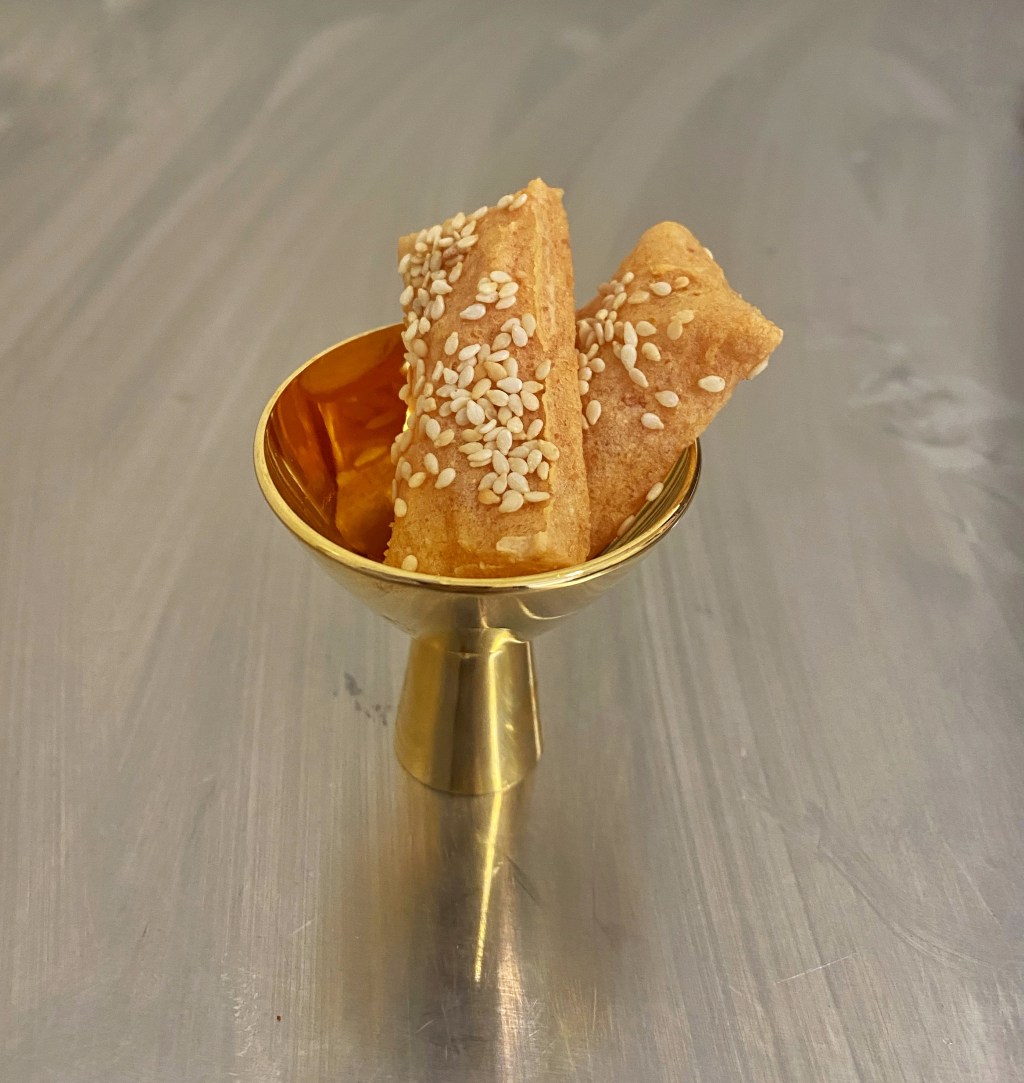

The first dish from the 2007 menu that I decided to try was the Parmesan Soufflés. At only four ingredients and not requiring much in the way of equipment, this felt like a good way to gently step into the project. Plus, the technique seemed interesting and my partner would be able to be around to sample the results with me.
The recipe makes 10 servings of two soufflés per serving and is meant to be served at room temperature. One thing I appreciate about the level of detail in the books is that Ferran Adrià included a recommendation for what time of year to serve each dish. These were recommended as being fine to serve year-round.
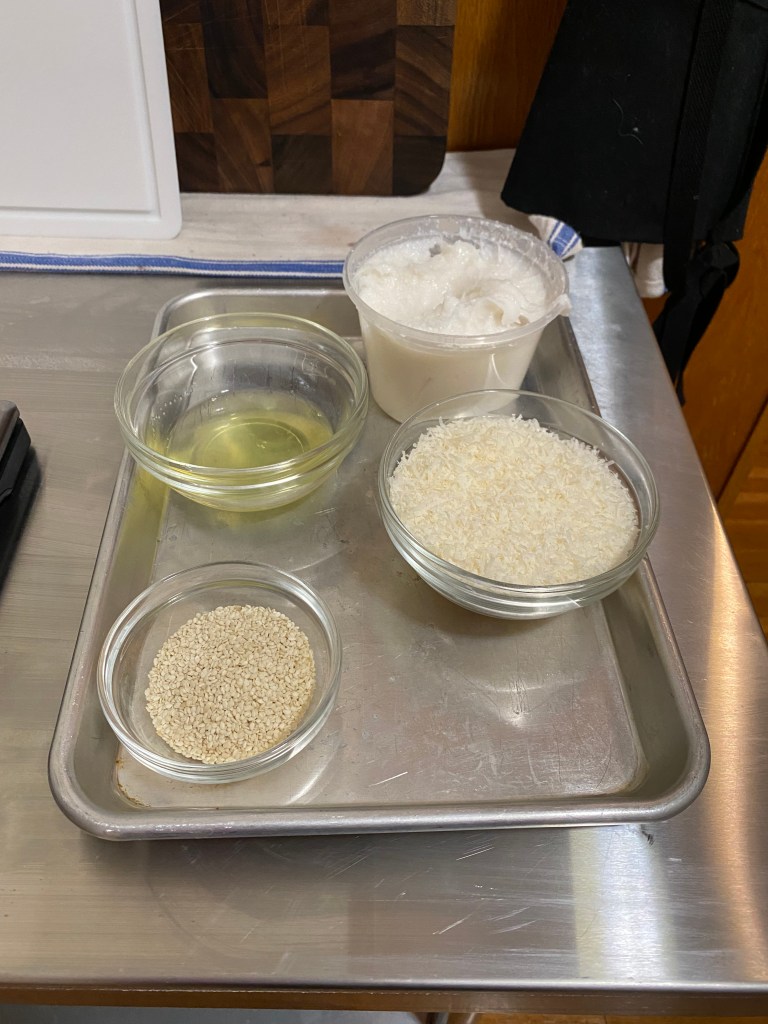
The dish called for first cooking 150g of rice in 500g of water. The water and rice was brought to a boil then lowered to a simmer until the water was all absorbed or evaporated. Converse to my above praise for the detail, there was no indication what type of rice should be used. It is entirely possible this information might be found in the Evolutionary Analysis volume, I have yet to finish reading it as it is overflowing with incredible information. So, I went with a simple organic white rice. Odds are I will revisit this dish a couple times with different rice varieties to find the optimal one.
Once the water had evaporated, I used an immersion blender to produce a very smooth paste. The purée was placed in the fridge to cool.
Once cooled, 175g of the rice purée was mixed with 53g of finely grated parmesan cheese until smooth. Then 50g of egg white was mixed in until the mixture was, once again, smooth. A Silpat mat was placed over a piece of paper with a 12cm by 30cm rectangle drawn in black marker and the mixture was spread to cover the rectangle and approximately 5mm thick. In hindsight, a much easier approach would be to use a piece of 5mm poster board with a 12cm by 30cm rectangle cut out of the center. I would also recommend, and will experiment with, using a second Silpat placed over the top to smooth it out. The sheet tray containing the rectangle was placed into the freezer until it froze solid after about 1 hour.
The block was carefully removed and a serrated knife was used to score the rectangle into 20 small rectangles approximately 6cm by 3cm. Working quickly, the rectangle was broken along the score lines. The rectangles were separated into four groups of five rectangles. I baked one group the same day and one group each of the next three days to see what effect time would have on the end quality. They were stored in air tight containers in the freezer until it was their time to be baked. This would help me understand how far ahead some of the dishes can be prepared when we attempt to make the entire menu.
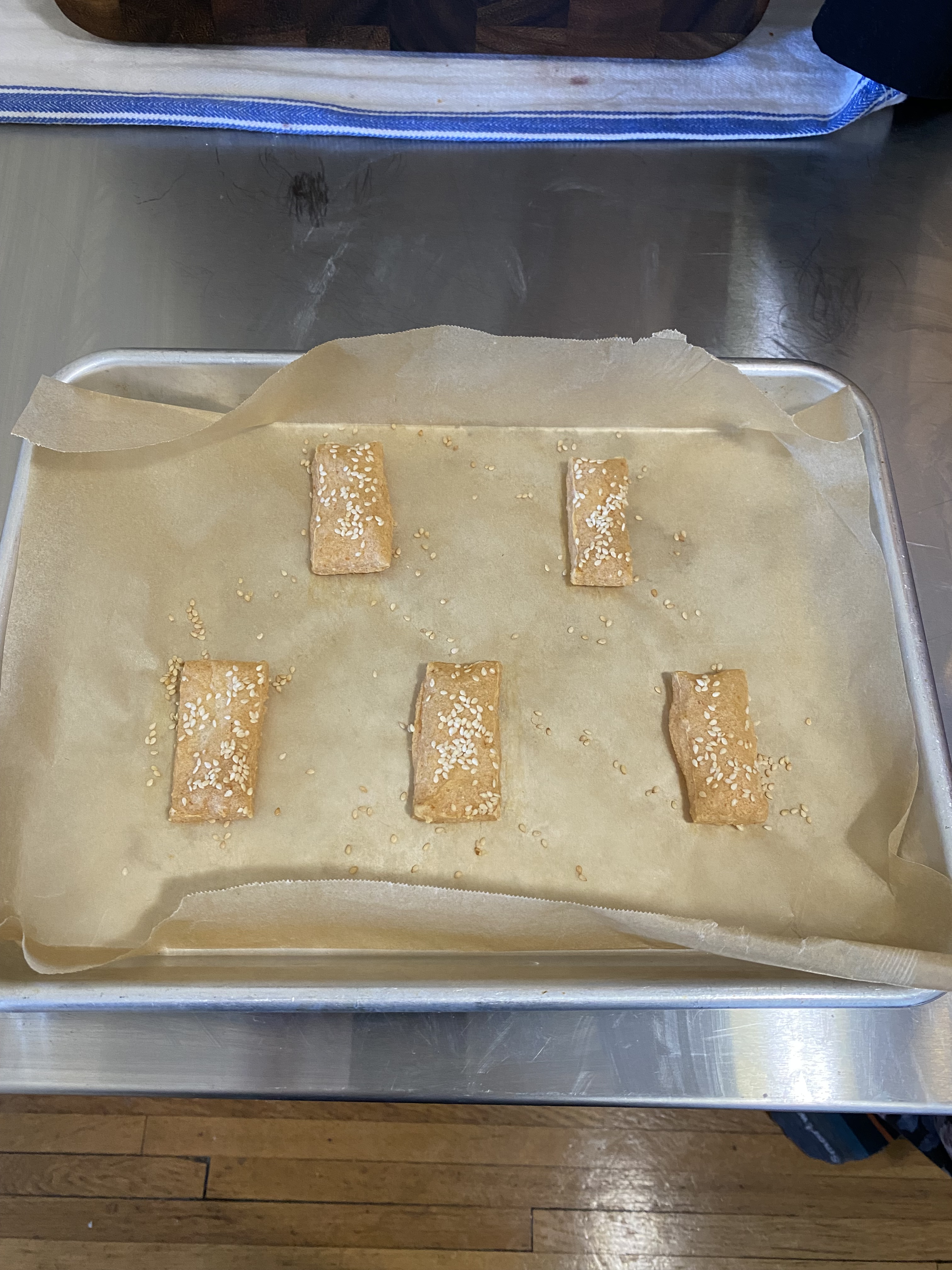
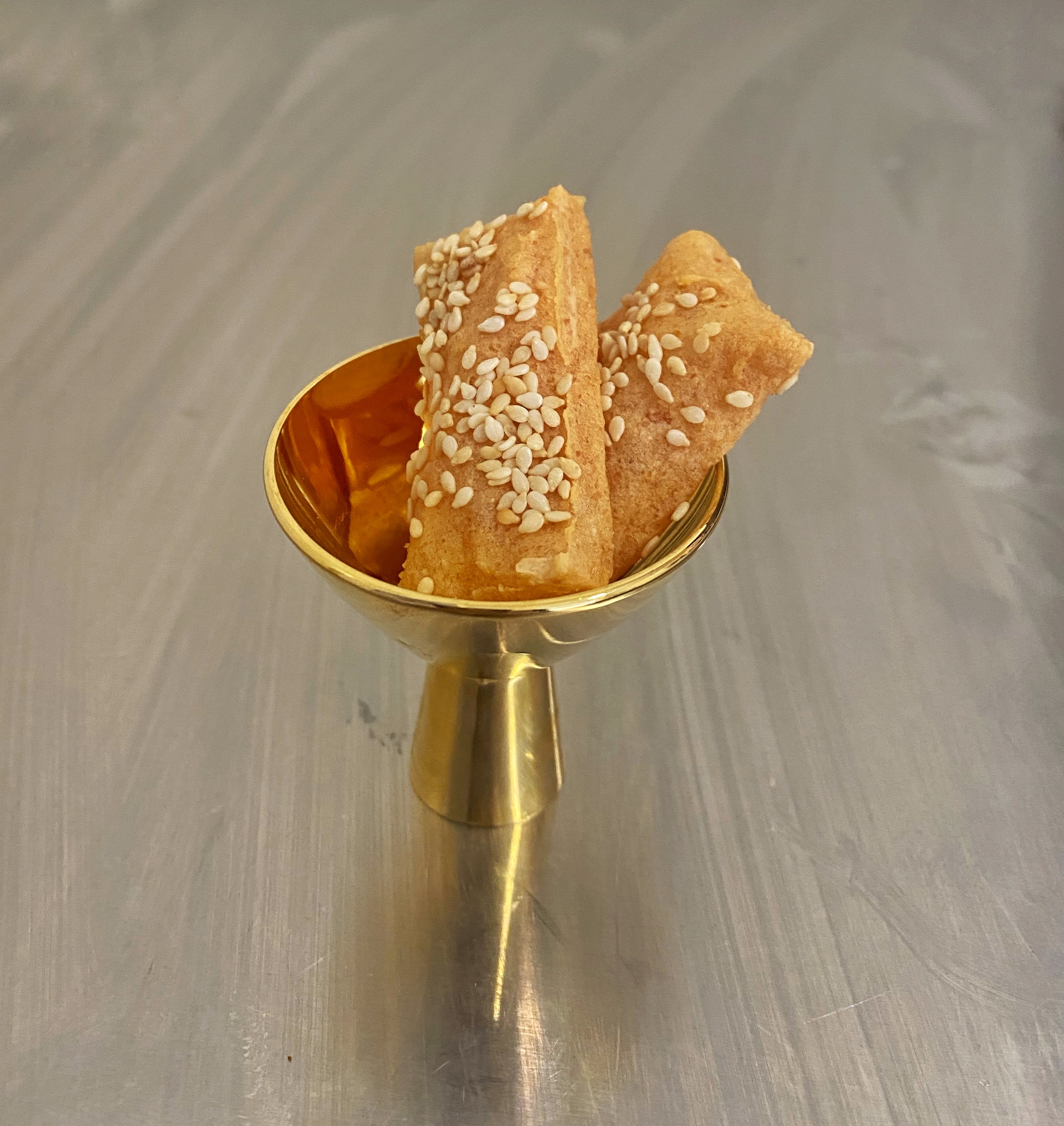
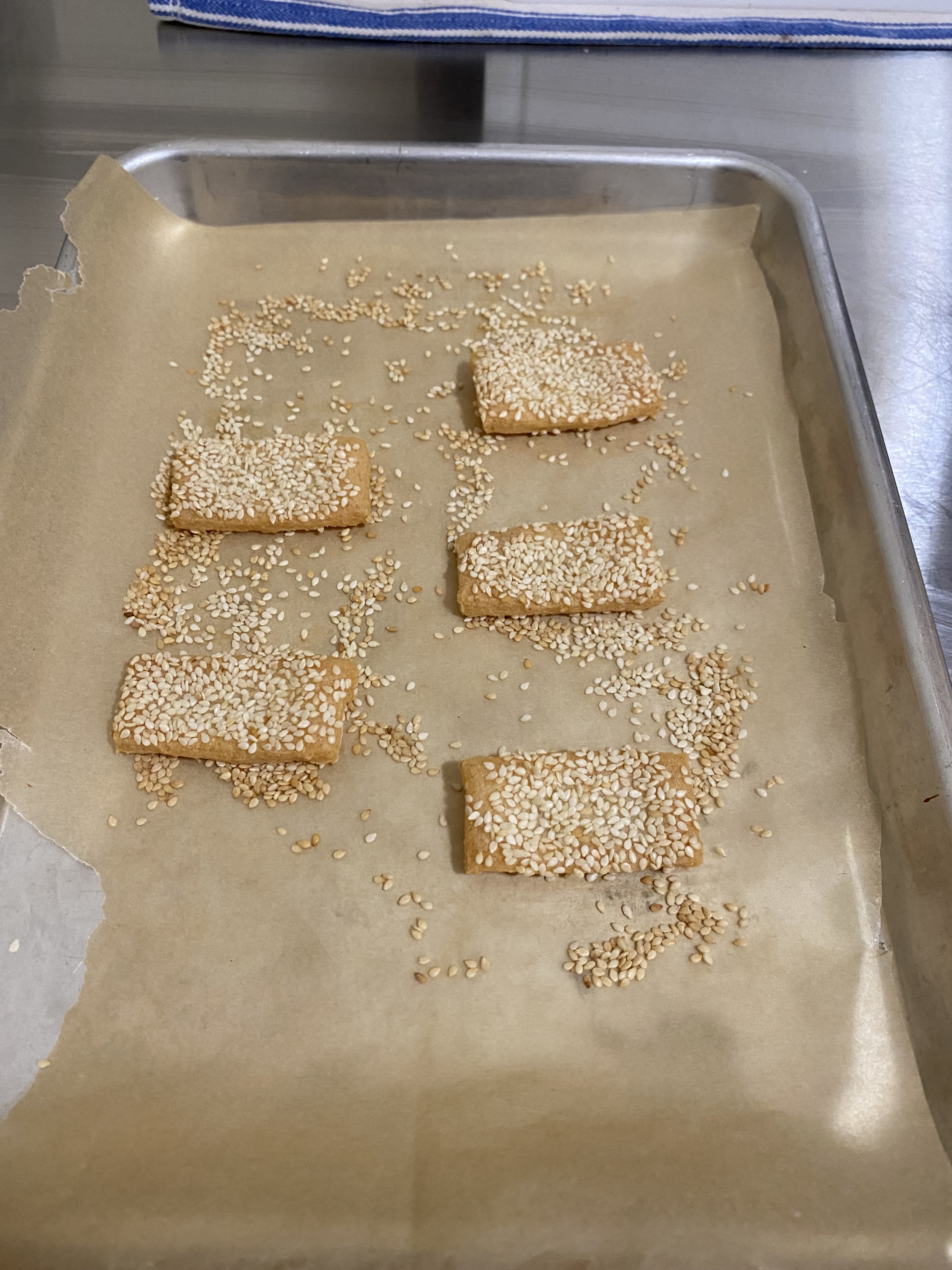
The first group, group 0, were baked the same day. They baked in a 155C oven for 55 minutes. The first group were baked with the convection setting on, which likely affected how well they puffed. Overall, the texture was delightfully crisp and the flavor was a lovely, intense parmesan. They made for a fun little bite.
The second group, group 1, were baked 24 hours later at the same temperature without the convection setting. Turning off convection seemed to produce a better puff and will likely be what I do moving forward. The texture and flavor were nearly identical to the previous day. I also took the opportunity to try plating them in a small gold sake glass. While I enjoy the idea of how they look, these will probably be served on a tray with the other four snacks from this course and the cocktail. It seems to make sense, logistically, to plate five dry snacks on a small dish for each dinner rather than trying to place 40 total dishes on the table for a single course.
The last two groups, groups 2 and 3, were baked 48 and 72 hours, respectively, after the first group. After 48 hours, the texture was notably changed. They weren’t as crisp and the flavor was less intense. I did, however, vary the amount of sesame seeds I used for each of these groups to see what affect this would have on the puffing. There seemed to be a fairly minimal amount of change due to the sesame seeds, as they puffed about as well as group 1 did.
This was not the perfect controlled experiment, as I had changed too many variables over the course of this single batch of 20, however, the recipe produces considerably more of the rice purée than is needed for a single batch of 20 so there will be plenty of room to experiment in a more controlled manner in the future.
On the whole, these were utterly delightful and both my partner and I loved the taste of these little snacks. Being that they are so easy to make, it is entirely likely that I will make a batch sometime for a small gathering.
The next recipe on the docket is the frosted blackberries, which we are very curious and excited to try.
 Their Cooking
Leave a comment